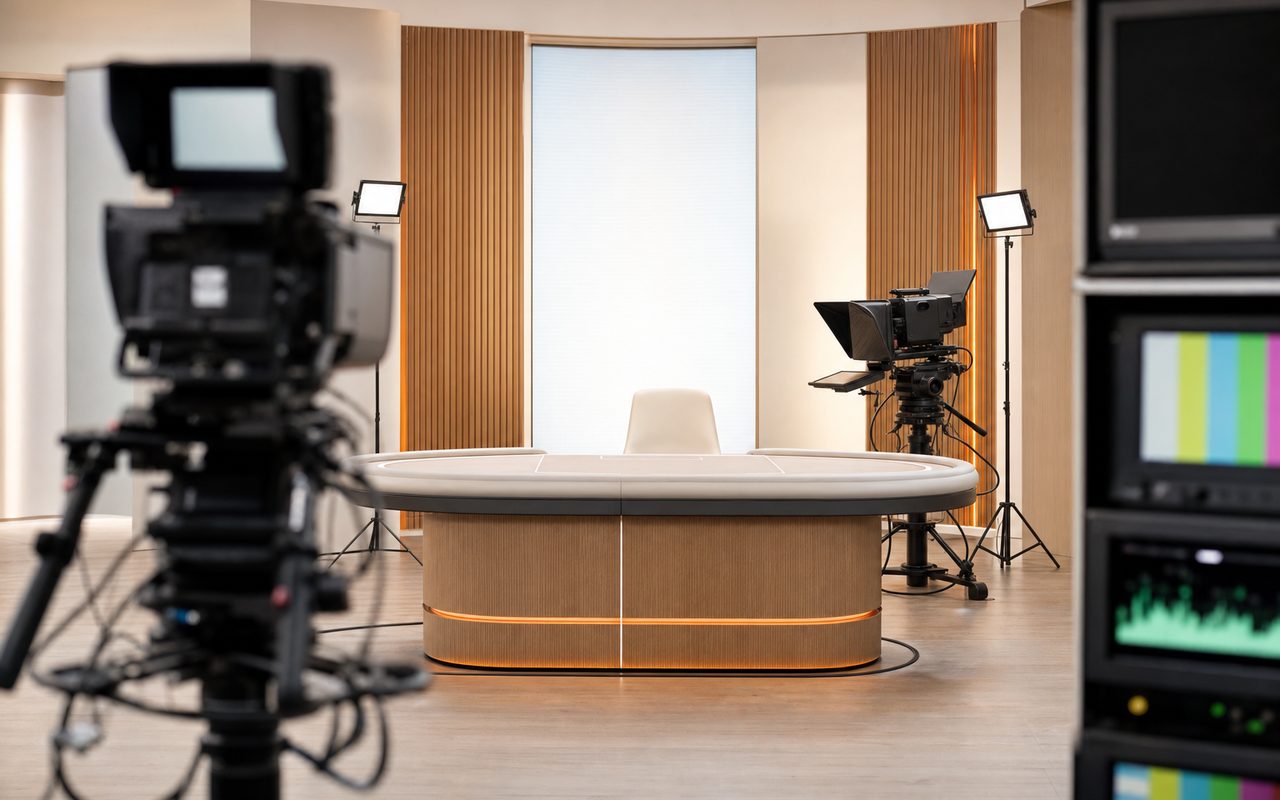
A Studio Floor, Not a Game Screen
Step into a live dealer facility and the vocabulary is immediately familiar. There is a lighting grid overhead, pedestals and jibs on the floor, a gallery behind glass with a vision mixer and talkback, and a wall of return feeds. The subject being covered happens to be a card game rather than a panel show, but the operation is a television facility that runs three shifts a day, every day, with no dark period in which to reset.
That continuous schedule is the defining constraint. Most production teams build a set, shoot against it, and strike it. A live table set is built once and then has to hold up under the same lights, the same lenses, and the same audience scrutiny for months.
Multi-Camera Grammar at a Single Table
A single table typically carries three to five cameras: a wide establishing angle that holds the presenter and the table together, a tight overhead or raked shot of the playing surface, a presenter close-up, and one or two specialist angles for the wheel, the shoe, or the dice. The cut pattern is tightly conventionalised, because the viewer needs to confirm the same sequence of facts on every round.
Much of the switching is automated and event-driven rather than called by a director in real time. Optical recognition of the cards or the wheel result triggers both the graphics layer and the cut, which means the camera plan has to be designed around machine-readable framing as much as around visual interest. It is a rare corner of production where the shot list is effectively a specification document.
Lighting and Audio for a Set That Never Goes Dark
Lighting a live table is a study in restraint. The key has to be flat enough for recognition systems to read the surface reliably, soft enough to flatter presenters across an eight-hour shift, and stable enough that nothing shifts when a fixture is swapped out mid-rotation. The three-point logic covered in the video production workflow still applies; it simply has to survive continuous operation rather than a single shoot day.
Audio is handled with the same conservatism. Presenters work on discreet lavaliers with redundant packs, table sound is captured separately so that the shuffle and the wheel remain audible under the voice, and the mix is kept deliberately dry. There is no post stage in which to fix any of it.
Why Regulated Markets Raised the Production Bar
Provincial regulation changed the economics of all this. When Ontario opened its regulated market, operators were suddenly competing inside a single jurisdiction on things players could actually see, and studio quality turned out to be one of them. Registrar standards published by the Alcohol and Gaming Commission of Ontario set expectations for game integrity and record keeping that read, in practice, as production requirements: verifiable camera coverage, retained footage, auditable results.
Consumer coverage followed the same line. Roundups of the best Ontario online casinos now routinely comment on where a studio is located and how its tables are staffed, and a National Post feature on the province's operators treats the live floor as a point of comparison rather than a footnote. Production value has become a consumer-facing attribute in a category that once hid it entirely.
Latency Is the Production Constraint
Every other decision bends around delay. A viewer watching a drama does not care whether the stream is fifteen seconds behind; a viewer who has to act before a betting window closes cares about every hundred milliseconds. Studios therefore run low-latency delivery paths rather than standard segmented streaming, accept a narrower bitrate ladder, and keep the encoding chain as short as they can.
The trade-offs are the familiar ones from any modern toolchain, weighed differently. Quality is traded for immediacy, redundancy is built at the encoder rather than in the edit, and the choice of codec and container is made on the basis of decode speed on a mid-range phone. The same evaluation discipline described in the media tools overview applies, with the scoring weights rearranged.
Presenters Are On-Air Talent
The people at the table are on-air talent working without a floor manager in the room. They handle continuity, read and respond to a text chat, keep to a pace set by the software, and stay in character through shift changes that happen mid-stream. The skill set sits somewhere between shopping-channel presenting and live sports hosting, and it is trained for accordingly, with scripted openings, timing drills, and playback review.
What Other Producers Can Take From It
The category is worth watching precisely because it took mainstream broadcast technique and pushed it into permanent, measurable, always-on operation. Continuous sets, automated switching, latency budgets, and talent working to machine timing are all arriving in other formats too, which is the convergence pattern described in the industry overview. Live dealer studios simply got there first, under commercial pressure that left no room for the comfortable assumption that anything could be fixed later.